From snapshots to continuous understanding: Rethinking off-gas testing for aeration performance
Authors: Sam Reifsnyder
Rocky Mountain Water Magazine

Authors: Sam Reifsnyder
Rocky Mountain Water Magazine
Aeration is essential to biological wastewater treatment, but it is also typically the largest energy user at a water resource recovery facility. Understanding how efficiently oxygen is transferred into wastewater can therefore significantly impact facility performance, energy use, and operating costs.
A recent article published in Rocky Mountain Water Magazine, “From Snapshots to Continuous Understanding: Rethinking Off-Gas Testing for Aeration Performance,” co-authored by Carollo’s Sam Reifsnyder, explores how continuous off-gas monitoring can provide utilities with a more complete picture of aeration performance.
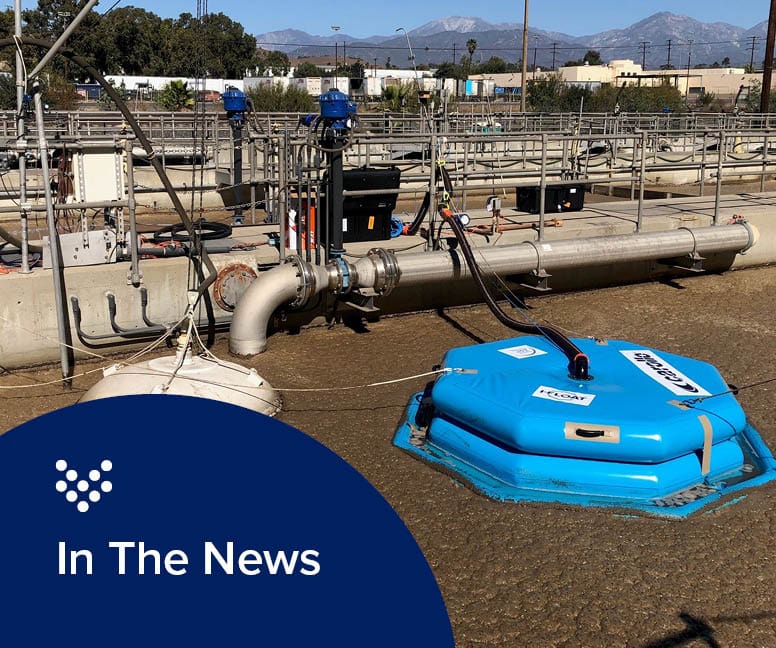
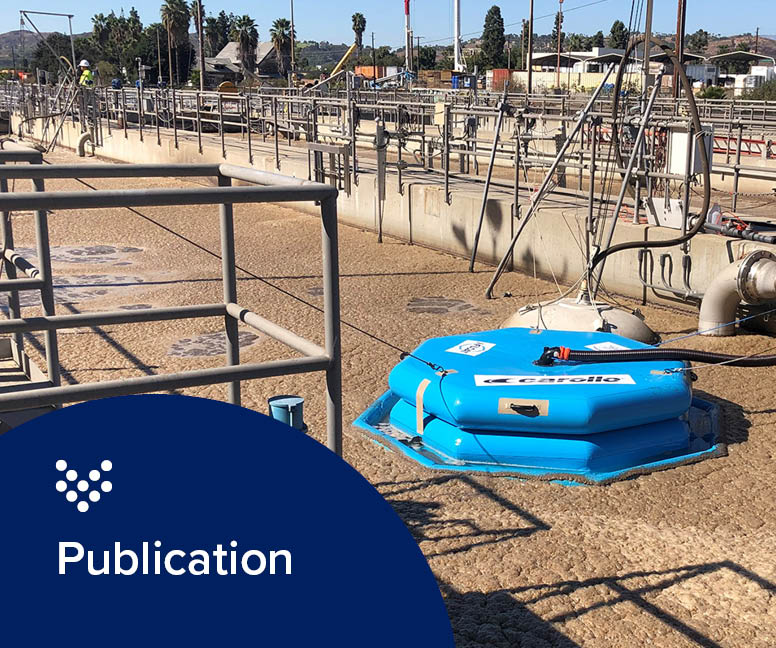
Off-gas testing measures the air leaving an aeration basin to determine how effectively oxygen is being transferred into the wastewater. Traditionally, this involves moving a collection hood between locations and taking measurements for relatively short periods.
The challenge is that aeration performance isn’t constant. Wastewater characteristics, biological activity, airflow, and other conditions change throughout the day, meaning a short test may capture only a snapshot of system performance.
New portable off-gas systems, like Carollo’s I-FLOAT, make it possible to monitor these conditions continuously, helping utilities understand not only how aeration performs at a specific moment, but how that performance changes over time.
The article highlights continuous off-gas testing at Metro Water Recovery’s Robert W. Hite Treatment Facility in Denver, where researchers compared conventional activated sludge (CAS) and densified activated sludge (DAS) systems.
In one monitored zone, the average alpha fouling factor (αF), a measure used to understand oxygen transfer efficiency under actual wastewater conditions, was approximately 0.42. However, values varied considerably throughout the day.
That variability can have real implications. Depending on when a traditional snapshot measurement was collected, engineers could reach different conclusions about aeration demand, blower capacity, energy consumption, and overall system performance.
Continuous monitoring also helped researchers identify when CAS and DAS systems performed similarly and where differences began to emerge under lower airflow conditions.
Advances in off-gas monitoring could provide benefits beyond aeration efficiency. Modern systems can also measure greenhouse gas emissions such as carbon dioxide, methane, and nitrous oxide.
As utilities focus on energy efficiency, process intensification, and emissions management, continuous off-gas monitoring can provide a more representative view of treatment performance and support more informed design and operational decisions.
Read the full article in Rocky Mountain Water Magazine to learn how continuous monitoring is expanding what utilities can learn from off-gas testing.
Citations
Reifsnyder, Sam, et al. “From Snapshots to Continuous Understanding: Rethinking Off-Gas Testing for Aeration Performance.” Rocky Mountain Water Magazine, vol. 58, no. 98, Sept. 2026, pp. 23–27.