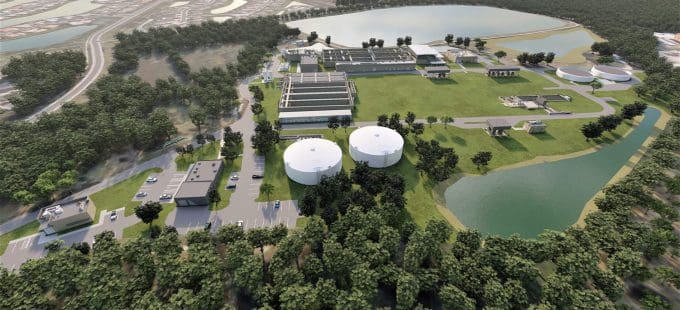
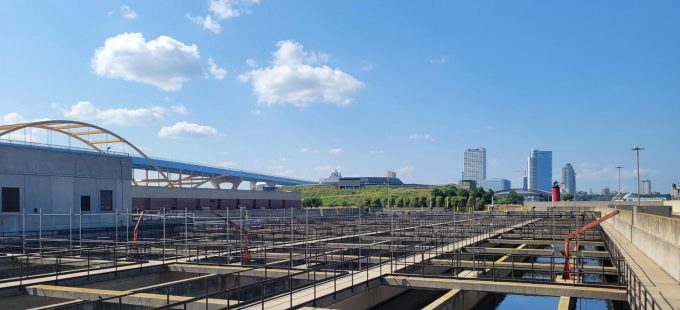
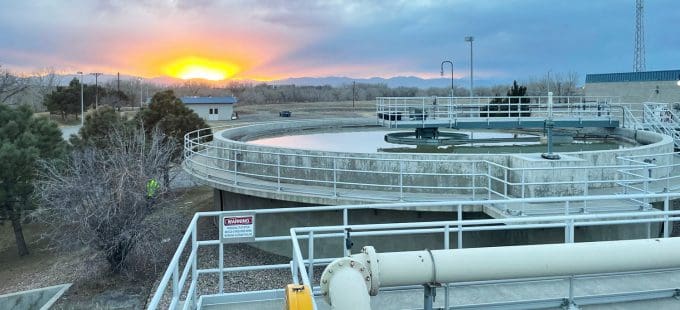
Los Angeles County Sanitation Districts Suboxic Nitrogen Removal at Pomona Water Reclamation Plant

Project Overview
In 2021, the Los Angeles County Sanitation Districts’ Pomona Water Reclamation Plant (PWRP), which handles on average 9 million gallons per day of activated sludge, set out to transition its biological nutrient removal (BNR) system to a low dissolved oxygen (DO) process—a groundbreaking advancement for the wastewater industry. BNR, which leverages bacteria to remove different forms of nitrogen, is an essential secondary treatment process: It is usually operated at high DO concentrations (>2 milligrams per liter), and the associated aeration can account for between 45 and 60 percent of a plant’s energy demand. This increases energy costs and puts stress on the electrical grid in vulnerable areas. By contrast, operating at low DO concentrations lowers costs, saves energy, and has the additional advantage of providing unprecedented control in aeration operations. However, only a handful of plants have implemented low-DO processes in the country, and, prior to the completion of the PWRP upgrade in 2024, there was little guidance for success.
Led by Carollo Engineers, the Los Angeles County Sanitation Districts partnered with seven entities to implement low dissolved oxygen operations at the PWRP. This $4.4 million effort was funded partly by a US Department of Energy project focused on transforming existing wastewater treatment systems into more energy-efficient processes with lower greenhouse gas emissions while establishing design and operational criteria for low-DO BNR. The project team combined state-of-the-art high-efficiency blowers, machine learning, and a focused design to reach low DO operations—to about 0.7 mg/L—over 10 phases and 11 months, reducing the plant’s aeration energy consumption by 57% and saving $200,000 annually. Crucially, the updated plant maintains nitrogen and phosphorous removal without increasing nitrous oxide emissions rates—a breakthrough that removes a critical barrier to widespread implementation.
There is a significant opportunity to carry this success forward throughout the wastewater industry. The project team, in addition to successfully implementing low DO at the PWRP, carefully documented the low dissolved oxygen transition over the course of two years, recording detailed information about microbial kinetics, microbial community adaptation, nitrous oxide emissions, design, operation, and control. The results of this study have been presented at more than 40 regional, national, and international conferences and webinars, and a corresponding US Department of Energy report is now publicly available. By making these lessons accessible to the industry, the project is accelerating the adoption of low dissolved oxygen technology and helping other utilities avoid common pitfalls in implementation. This knowledge transfer extends the project’s impact far beyond PWRP, potentially influencing energy efficiency and treatment effectiveness across facilities nationwide.
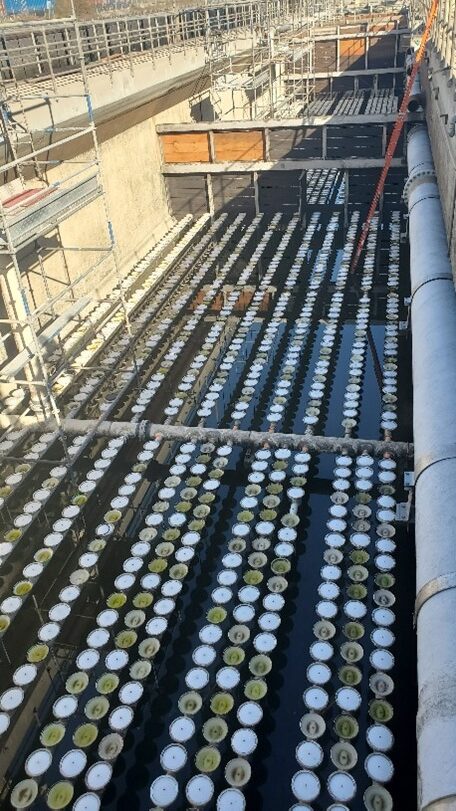
Results and Highlights

The team integrated high-efficiency blowers, machine learning, and a strategic approach to operations to achieve low-DO operations.
The new process reduced the plant’s aeration energy consumption by 57% and saved $200,000 annually.
The plant maintains nitrogen and phosphorous removal without increasing nitrous oxide emissions, enabling widespread implementation
Project Awards and Accolades

CASA