Jack Malace
Engineer

As gigawatt-scale projects surge across the United States, “doing water right” can determine whether communities see opportunity—or risk.
Scrolling through LinkedIn, it feels like a new gigawatt-scale data center project is announced somewhere in rural America every week. Texas, Ohio, Oregon, Virginia, Oklahoma—the list goes on and on. Billions of dollars are being invested in power, semiconductor manufacturing, and real estate, all in the name of artificial intelligence.
Between 2025 and 2030, capital spending to enable AI infrastructure, including data centers, semiconductor manufacturing, power plants, water infrastructure, and their supply chains is expected to reach roughly $5 trillion, or around 3 percent of gross domestic product. The last time the country invested in infrastructure at that scale was during the railroad boom of the 1800s. Then, railroads reshaped commerce, accelerated industrialization, and permanently altered how the nation functioned. Today’s AI-driven buildout may not look like steel rails stretching west—but its economic and societal impact could be just as transformative.
In the communities where data centers are proposed, enthusiasm is often mixed with skepticism. In 2025, an estimated $65 billion in data center investments were delayed or abandoned due to local opposition. Among the most common concerns are water use, water and air quality, and power demand, including potential impacts on local infrastructure, user rates, and the environment. Because water is integral to both cooling systems and power generation, these concerns are often interconnected.
For some rural communities, the skepticism is deeply rooted. Many have lived downstream of heavy industry for decades and are wary of new development that could stress already constrained infrastructure or introduce additional environmental risk. Others question whether local ratepayers should subsidize water, wastewater, and power system upgrades that primarily serve private facilities. In response, some states and municipalities are considering moratoriums or outright bans on new data center construction.
These concerns cannot be dismissed. They are rational, experience-based, and increasingly influential in project outcomes.
Water decisions shape data center site selection, permitting, community trust, and long-term operating costs and should be addressed early in project planning.
As computing density increases, equipment becomes more complex, and facilities expand in square footage, traditional air cooling is no longer sufficient or economical.
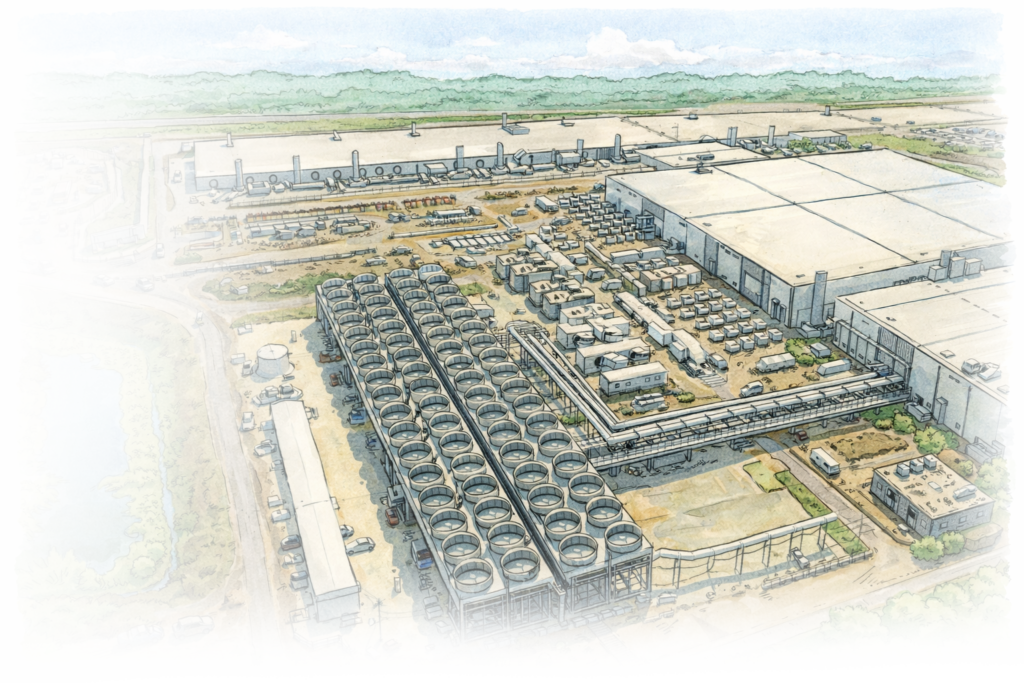
Older data centers commonly relied on water-intensive evaporative cooling towers. Newer facilities increasingly use closed-loop fluid coolers, which function much like automobile radiators, moving large volumes of air over large surface areas to dissipate heat.
As a result, many owners are moving toward these closed-loop strategies for most of their cooling needs, while using limited evaporative cooling only during the hottest days of the year. Liquids are far more effective than air at carrying heat, enabling higher performance in smaller footprints.
Cooling systems also raise questions about chemical use and environmental risk. In reality, the treatment approaches used in closed-loop systems closely resemble those long employed in hospitals, universities, and advanced manufacturing facilities. By adopting proven practices, such as tighter containment, automation, and monitoring, chemical and environmental risks can often be reduced significantly.
Much of the industry is transitioning to closed-loop strategies for the vast majority of cooling needs.
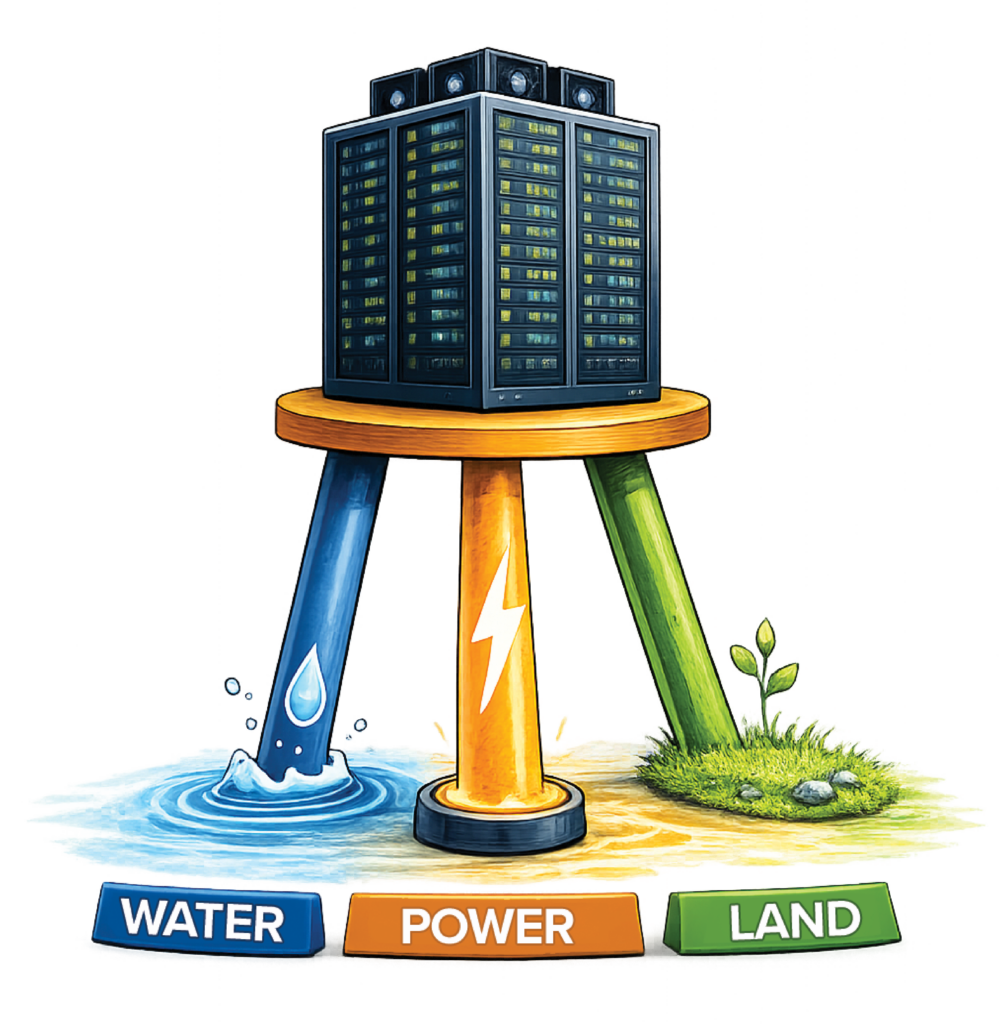
Data centers ultimately rely on three foundational resources: water, power, and land. Public discourse tends to focus on land acquisition and grid capacity. Water, by contrast, is often treated as a secondary issue until late in the project lifecycle, when it becomes an expensive and highly-visible constraint.
New construction is only part of the story. Thousands of existing data centers still rely on evaporative cooling towers, and many owners are actively seeking ways to reduce water consumption and improve resilience.
In 2025, Carollo completed a cooling tower blowdown reclaim project for a data center client focused on maximizing water use while minimizing freshwater withdrawals. The project demonstrated that existing facilities can often be retrofitted using commercially available technologies, resulting in reduced water demand and improved operational flexibility.
A well-designed water strategy does more than reduce consumption; it builds trust. Doing water right means:
Importantly, water impacts extend beyond the data center fence line. Power generation can carry significant water implications of its own, reinforcing the need to evaluate water and power together.
When water is done right, data centers can operate with minimal water resource impacts and a clearer path to community support. When it’s not, water becomes a public relations crisis and a reason that projects are delayed or built elsewhere.