Alan Roberson
Water Policy and Advocacy Consultant

May 30, 2026



On May 18, 2026, the EPA announced a proposed rule to allow public water systems (PWS) to seek a federal exemption for two additional years to comply with the Maximum Contaminant Levels (MCLs) for perfluorooctanoic acid (PFOA) and perfluorooctane sulfonic acid (PFOS). The extension will shift the compliance date from April 26, 2029 to April 26, 2031 for approved systems.
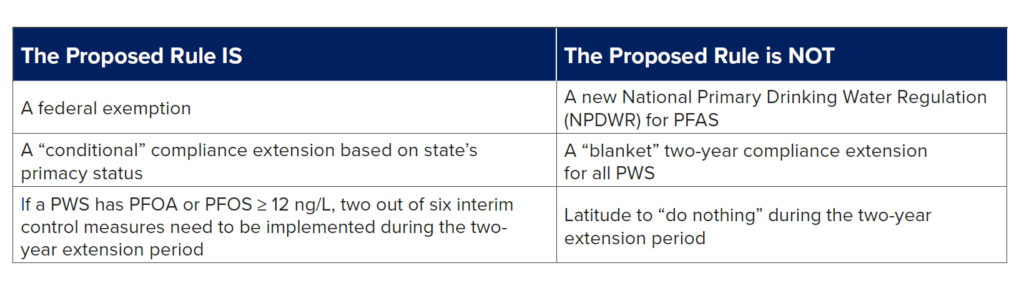
While this extension is possible under the exemption provision in Section 1416 of the Safe Drinking Water Act (SDWA), the process is unprecedented and could cause confusion and more regulatory uncertainties for PWS.
So far, nine states have initiated state-level rulemaking to incorporate the new PFOA and PFOS drinking water standards and have submitted a primacy program revision application to EPA for approval. These states include Vermont, Illinois, Maryland, Connecticut, Colorado, Washington, Wisconsin, Idaho, and North Carolina. Once a state obtains primacy for the NPDWR for PFAS, EPA can no longer grant federal exemption to PWS to extend the compliance deadline.
Primacy is the primary enforcement responsibility delegated by the EPA to a state, territory, or federally recognized tribe to implement and enforce federal drinking water regulations. States with primacy enforce the drinking water regulations and oversee the local water systems. In contrast, EPA has enforcement authority for states without primacy (Wyoming and District of Columbia). Therefore, PWS will need to factor in the state’s primacy status when deciding whether to pursue EPA’s exemption.
Because of the timing of this rule, states will be working with EPA to establish primacy for the PFAS NPDWR at the same time that water systems may be applying for an extension. This situation can create confusion regarding who (EPA or states) has authority to implement this rule during the transition phase. Water systems are advised to work closely with state primacy agencies for guidance on which agency should make the final decision on the approval and duration of the extension.
Under the proposed rule, PWS seeking a compliance extension that have one PFOA or PFOS sample result at or above 12 ng/L would be required to choose and implement at least two out of six control measures during the exemption period to minimize public exposure to PFOA and PFOS.
The six control measure options include:
EPA is proposing that the two control measures selected cannot solely include public education materials and public outreach activities (options 5 and 6).
If a PWS seeking a compliance extension has PFOA and PFOS levels above the MCLs of 4.0 ng/L but below 12 ng/L, NO control measures would be required during the exemption period.

Our team can support PWS through each step of the process, from drafting and submitting comments on the proposed rule; coordinating with regulators for compliance approvals, including the two-year extension; testing, designing, and constructing treatment systems; and providing public outreach support.