
Alan Roberson
Water Policy and Advocacy Consultant

June 12, 2026



On May 18, 2026, EPA announced a proposed rulemaking to rescind maximum contaminant levels (MCLs) for PFHxS, PFNA, HFPO-DA (commonly known as GenX chemicals), and Hazard Index (HI) mixtures of these three PFAS plus PFBS. EPA justified this rollback by citing procedural violations in how the National Primary Drinking Water Regulation (NPDWR) was issued, stating that the process violated the Safe Drinking Water Act (SDWA) by combining regulatory determinations and rulemaking for these PFAS in a single step.

The rescission does not affect PFOA and PFOS regulation. EPA is maintaining the MCLs of 4.0 ng/L for PFOA and PFOS. However, if the rescission rule is finalized, PFHxS, PFNA, HFPO-DA, and PFBS would lose their status as regulated contaminants. EPA has emphasized that this change is not an abandonment of concern about these PFAS, but rather a restart of the rulemaking process to consider regulating them in the future with proper scientific review and public input. Notably, EPA has signaled its intent to evaluate additional PFAS for future drinking water regulations and potentially develop new standards for these PFAS under a revised rulemaking process.
EPA’s move to rescind previously finalized MCLs is unprecedented and could face legal challenges. The SDWA contains an anti-backsliding provision that prohibits standards that are less protective of public health unless new data or analyses justify such changes. EPA will likely argue that the rescission is a procedural reset rather than a substantial weakening of previously established standards, creating ongoing uncertainty for the regulation of other PFAS beyond PFOA and PFOS.

These PFAS monitoring and data reporting milestones are unchanged by the proposed MCL rescission rule. Water systems will still need to meet compliance deadlines for PFOA and PFOS.
The initial monitoring and data reporting deadline (April 26, 2027) remains unchanged from the original timeline. If the rule is amended, compliance monitoring would only be required for PFOA and PFOS, likely reducing analytical costs and data reporting complexity for public water systems.
As of January 2026, 11 out of 12 batches of Unregulated Contaminants Monitoring Rule 5 (UCMR5) data have been released and 10,289 systems have sampled for PFAS.
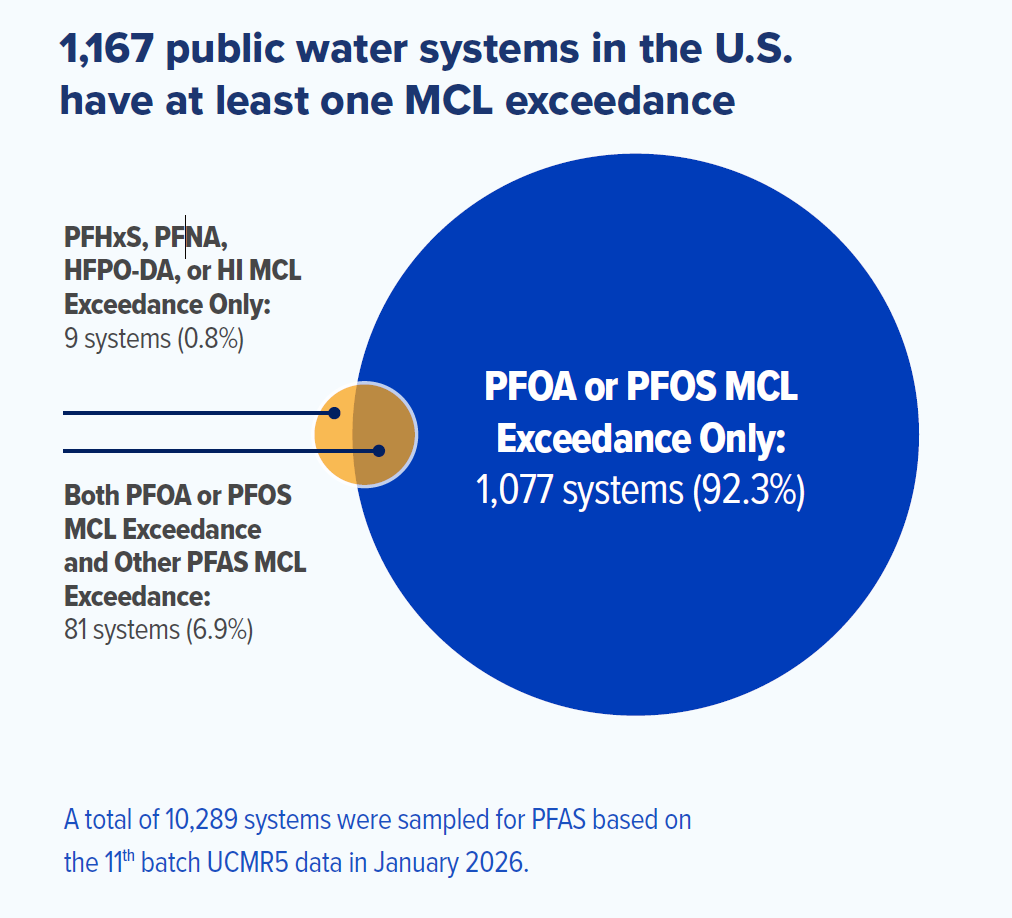
A total of 1,167 public water systems have at least one MCL exceedance for PFOA, PFOS, PFHxS, PFNA, HFPO-DA, or HI. Of these, over 92% of systems have only PFOA or PFOS MCL exceedance.
Only nine systems nationwide (0.8%) have MCL exceedances for PFHxS, PFNA, HFPO-DA, or HI only. These data indicate that only a small percentage of systems will be able to avoid PFAS treatment if the proposed MCL rescission rule is finalized.
Our engineers can support every step from planning through compliance: