Harvest Water Capital Program Management Services

Project Overview
In southern Sacramento County, declining groundwater levels are threatening the region’s water sustainability and the health of its wetland and riparian habitats. Modeled climate impact scenarios indicate that, without intervention, groundwater levels will only continue to fall, further impacting the local ecosystem. In response to this growing issue, the Sacramento Area Sewer District (SacSewer) developed California’s largest agricultural water recycling project: the landmark $597 million Harvest Water Program. This program will enable local growers to use high-quality recycled water instead of pumped groundwater for irrigation, which will not only reduce groundwater pumping, support habitat restoration efforts, and provide a multitude of benefits to the Sacramento-San Joaquin Delta, but also confer a variety of benefits to local growers. The program’s goal is to provide up to 50,000 acre-feet or roughly 16 billion gallons per year of drought-resistant, affordable recycled water to growers within the 16,000-acre service area.
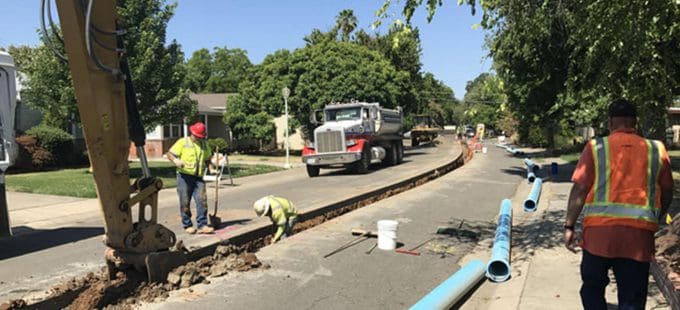
In 2020, SacSewer selected Carollo Engineers as part of a joint venture team to oversee the design and construction of Harvest Water’s capital projects. These included a high-capacity, 105-million gallon per day (mgd) pump station; 43 miles of 12 to 66-inch diameter pipelines; and nearly 100 on-farm connection assemblies to control the delivery of water to agricultural customers. The success of this project is directly tied to the recently upgraded $1.7 billion EchoWater Resource Recovery Facility, which included $550 million in construction projects designed by Carollo and now produces disinfected tertiary recycled water suitable for irrigation.
In addition to providing essential technical expertise, Carollo has also played a critical nontechnical role in this project. Scott Parker, a senior vice president at Carollo and owner of a farm-to-table beef operation, has been instrumental in bridging the gap between SacSewer and local growers. He has met extensively with the growers in the project area to discuss the specifics of the Harvest Water Program, an effort that was critical to establishing consensus with the agricultural community. More than 75 growers have already signed service agreements to receive water from the program, out of a target of 100 growers.
The program management team has also developed a custom water ordering and management solution for growers: the Harvest Water Enterprise Management System. The grower interface works across multiple platforms, including smartphones, tablets, and desktop computers, allowing growers to order their water remotely and schedule deliveries. Deliveries will be controlled remotely from SacSewer’s treatment facility via cellular communications with each grower’s turnout. Other features include system monitoring and diagnostics, as well as order tracking for billing purposes.
The Harvest Water Program, once completed, will raise local groundwater levels by up to 35 feet over 15 years and increase groundwater storage by approximately 370,000 acre-feet. This outcome is expected to provide new sanctuaries for threatened species such as Swainson’s hawk, benefit groundwater-dependent ecosystems, reduce salinity and nutrients in the Sacramento and Delta waterways, support fall-run Chinook salmon, and boost sustainable agriculture. By benefitting both local growers and local ecosystems on a large scale, this project will set new standards for sustainable water development and collaboration in agriculture.
Results and Highlights

California’s largest agricultural water recycling project supplies affordable recycled water, reducing reliance on pumped groundwater.
The project features a 105-mgd pump station, 42 miles of pipelines, and 100-plus on-farm connections
The project will raise groundwater by ~35 feet and increase storage by 370,000 acre-feet.